The Dance of Death of Pinzolo: A 16th-Century Masterpiece
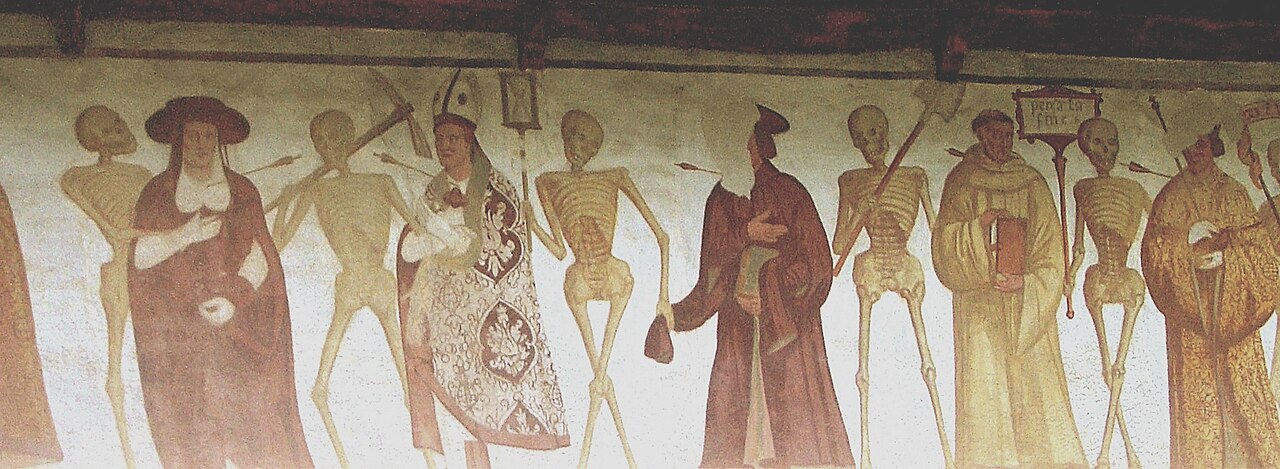
The Dance of Death of Pinzolo, painted by Simone Baschenis de Averara in 1539 on the Church of San Vigilio, is a masterpiece of Alpine mural painting featuring approximately 40 figures across 21 meters of wall. Discover the meaning, the vernacular inscriptions, and the comparison with the Carisolo fresco.
Simone Baschenis and the Itinerant Painting Tradition
The Dance of Death of Pinzolo is one of the absolute masterpieces of Alpine mural painting, a work that for nearly five centuries has fascinated and unsettled anyone who contemplates it. Its author, Simone Baschenis de Averara, belonged to a celebrated family of itinerant painters originally from Val Averara, in the province of Bergamo, who for generations traveled the Alpine valleys of Trentino, Tyrol, and Lombardy.
The Baschenis carried with them an extraordinarily rich iconographic repertoire, handed down from father to son, which included biblical scenes, lives of saints, Last Judgment representations, and Dances of Death. Simone was probably the most talented member of the family, capable of combining late-Gothic tradition with Renaissance influences. In Val Rendena, his hand is recognizable in numerous churches, but it is in Pinzolo that he created his undisputed masterpiece.

The Church of San Vigilio and the 1539 Fresco
The Dance of Death is painted on the southern exterior wall of the Church of San Vigilio, the main sacred building of Pinzolo, situated on a panoramic hill overlooking the town center and the valley below. The fresco was created in 1539, as attested by an inscription on the work itself.
It is a monumental painting extending approximately 21 meters in length and depicting a procession of about 40 figures arranged in pairs: each pair is composed of a skeleton (Death) dancing and dragging along a representative of a different social class. The fresco reads from left to right as a visual narrative:
- Figures of power — the pope, the emperor, the king, the cardinal
- Figures of authority — the bishop, the knight, the judge
- Figures of knowledge and commerce — the doctor, the merchant, the lawyer
- Figures of the people — the farmer, the craftsman, the beggar
- The most touching figure — a swaddled infant, reminding us that no one escapes Death
The Vernacular Inscriptions: The Voice of Death
One of the most extraordinary aspects of the Dance of Death in Pinzolo is the presence of verse inscriptions written in Italian vernacular (with dialectal inflections) accompanying each pair. In these inscriptions, Death itself speaks, addressing each character in a tone that is now ironic, now mocking, now compassionate.
To the pope, Death says that not even his spiritual power can save him from the grave; to the wealthy merchant, it reminds him that he cannot take his riches with him; to the doctor, it points out that despite his knowledge he could not cure himself. These poetic captions transform the fresco into a true visual literary text — a kind of popular sermon intended for the faithful, many of whom were illiterate but perfectly capable of understanding the message through the images. A heritage that fits within the rich history of Val Rendena.
Meaning and Symbolism of the Dance of Death
The theme of the Dance of Death (in Latin Chorea Machabaeorum) is one of the most widespread iconographic subjects in late-medieval and Renaissance European art, born as a cultural response to the great plague epidemics that devastated the continent from the 14th century onward. The fundamental message is that of the equality of all people before death.
In Pinzolo, this theme takes on a particular significance tied to the social context of 16th-century Val Rendena — a farming and pastoral society, deeply religious, in the territory of the Giudicarie. The Dance of Death is not a message of despair: it is an invitation to live well, to piety, charity, and spiritual preparation. The key themes of the work:
- Memento mori — the reminder of mortality as a motivation to live righteously
- Universal equality — neither power, nor wealth, nor youth can save from death
- Social satire — subtle criticism of the powerful and the vain
- Invitation to charity — good works as the only true treasure
- Popular tradition — art as a communication tool for the people
The Dance of Death in Carisolo: An Illuminating Comparison
The Dance of Death in Pinzolo is not an isolated case: a similar work, painted by the same Simone Baschenis but twenty years earlier, in 1519, can be found on the facade of the Church of Santo Stefano in Carisolo, a few kilometers north of Pinzolo. The Carisolo fresco, while sharing the theme and compositional layout, presents significant differences in style and choice of characters — a fascinating comparison for appreciating the artistic evolution of Baschenis.
Over the centuries, both frescoes have suffered damage from weather and humidity. The last significant restoration dates to the 2000s, conducted by the Cultural Heritage Office of the Province of Trento. Today both churches are freely accessible and represent an unmissable stop for anyone visiting Val Rendena.

Visiting the Dance of Death: Practical Information
The Church of San Vigilio is located in the historic center of Pinzolo, easily reachable from Madonna di Campiglio in about 15 minutes by car. The fresco is visible on the exterior of the church at any time, but for a thorough understanding of the work, attending the guided tours organized by the Ecomuseum of the Judicaria and the Campiglio Tourist Board is recommended. A visit to the Dance of Death combines perfectly with an excursion to the nearby Val Genova, a walk along the Sarca River, or a visit to the Adamello Brenta Nature Park, creating an itinerary that unites art, history, and nature in the heart of the Alps.